

My apprenticeship did not take the usual course; I was the master of my master on the first day. Vinurd was a kind man, a man with clever hands and a quick mind. At first he had me sweeping up the chippings and roughly shaping the flint before he did the fine work, but he quickly saw that I was not for such tasks. He laughed when he realised what I could do. On that first day, I could make an arrowhead neater and faster and better than he could. He was vexed briefly, but then when he sat and watched me at it, he laughed. It was so easy for me, he said. I hardly had to move. It tickled him.
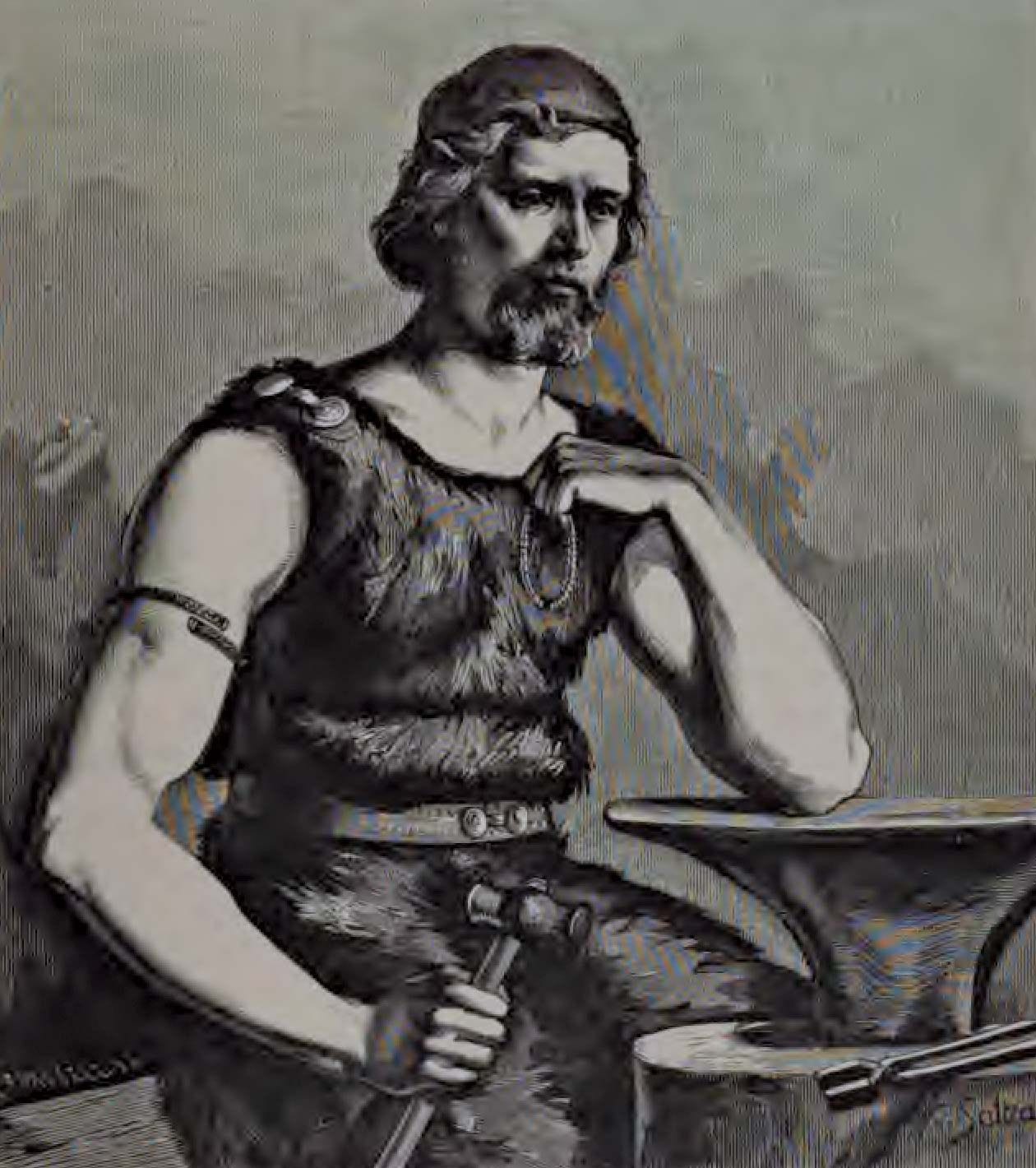
‘And your father refuses to take you?’ he said. ‘Hilarious! Well, we’ll keep quiet about this for now, Wayland. Some day, we’ll take him by surprise.’
So the shame of not being taken on by my own father was to be turned back on him in days to come.
Let me tell you about work. There are things you can learn; how the grain of the stone works, how it is best held, best struck, into what it may be best made. You can look at a piece and see that is good or bad. You can see what it might become. You can see how it is that a tap here, a blow there, might give you the edge you want in the place that you want. These skills are all gone now. Long ago I used to go across Midgard to see the peoples that knew about the stone, but now you are all seduced by the new things I brought to you, to make the things you want.
But there are things you can’t learn. How to tap a stone just so, so that the chips fall off its side like the petals from a flower, revealing the tool that was hidden inside all the time. How to kiss the stone so sweetly and with such love that a misplaced chip may creep back in its place with no fault within or without. How to squeeze the stone very gently in the hand so that it changes texture - harder, softer, kinder, sharper. These kinds of tricks. These, where the trouble began.
It was a while before I showed them to Vinurd. I was suspicious - suspicious of myself, suspicious of him. I had already learned that no one else knew the things I knew, but I did not know what that meant. Were they a good thing or bad? Had I these gifts by grace or by a curse? I was scared, but each day I pulled my courage out of its bag, inch by inch, as I learned to trust Vinurd more.
‘Look, Vinurd, I have a new trick?’ I said at last. ‘Look, look. It needs a light touch. Just so,’ I said. I was gabbling. I knew this wasn’t right. My heart was galloping
‘Show me,’ he said.
I held the stone in my hand, cupped lightly. I took the hammer stone and I struck it in just the right place. The stone crinkled. The flakes fell away from the sides in perfect semi-circles. I shook them away. In my hand now lay a long spear head. Just so. Just right. As it always had to be.
Vinurd was sitting next to me. He frowned. ‘Wayland, what was that? Some trick …?’
‘No, not a trick,’ I said. My heart was beating hard. I felt that fate was knocking at my door - knocking at my heart.
‘Can you do it again?’ he asked.
‘I can,’ I replied, and I noticed there was sadness in my voice, although I didn’t understood why.
He picked up a stone from the pile by his foot, roughly shaped already. ‘Make me an axe this time. Can you?’
‘Yes, but not with that stone …. Look, this one. This one, this one has an axe inside.’
He looked at me sharply for my language - a tool is made, not found. So he thought. Well, it was like that for him. I held the stone loosely in my hand, and poised the hammer stone above it. I paused.
‘You must know what you want or stone will not perform.’
Again he frowned at my language. Then he nodded. I nodded; then I stuck the stone. The flakes fell. The axe emerged.
Vinurd smiled sourly. ‘The stone has performed,’ he said. ‘Or was it you?’
‘Don’t you know this?’ I said, lying, as I knew he could not. ‘Here - try. A light touch …’
‘A light touch,’ he said, smiling wryly.
‘Look, ….’ I gabbled. I think at that moment I wanted more than anything else for him to have this skill. I did not want to be special. I was a child of the tribe, a boy who wanted to be normal, like the others. ‘This stone, there’s an axe in here. Smaller I think. Here, Vinard, here …. you hold it like this …’ I said, shaping his hand around the stone … his rough fingers in mine. I remember that moment so vividly, because he lifted his eyes and we both paused a moment, looking at each other. He smiled. He knew. I knew. We knew.
‘You must strike it there. Just so. As if you are taking off less than a single chip or it doesn’t work.’
‘Wayland. You must know that no one else can do this but you.’
‘ No, no. Please, Vinurd. Try. Try, won’t you?’ I said. I begged. So he did as I asked, and heft the stone in his hand, glancing at me to see if it was held right. Then he stuck it with the hammer stone - my own hammer stone I had given him in case this was the magic, this was the thing that made it happen. He struck, neatly and sweetly as he knew how very well - he was after my father our best napper. And nothing happened.
‘Again. Try again. It must be learned. Everything must be learned,’ I lied.
He tried, bless him, a few more times, just to prove to me I think, before he put the stones down and took my face in his hands. I was gabbling, almost crying now.
‘This cannot be learned, Wayland. It cannot be learned.’
‘It is, it can, anyone can do it, you can do it,’ I gabbled. But he he took me in his arms and suddenly held me firmly to his chest.
‘It you, Wayland,’ he said again. ‘It’s just you. Only you.’ I began to cry then, big tears, big chest heaving sobs, because he had confirmed what I feared; that although I was of my people, I was not of my people. And all I ever really wanted was to be of my people.
‘There. Cry now. This is the time for tears … I know, I know. I know, Wayland.’
So he held me hard and stroked my head until my tears were all out of me. Then he held my shoulders at arms length and peered into my face.
‘What are you, Wayland? A witch, a magician, an elf?’
‘I am of the people,’ I said. This is how we answered all such questions. I spoke with no hesitation.
‘Then we are a very lucky people. Tell me - how do you do these things? Did you learn them? Off whom?’
‘I never learnt them. The stones ….’ I trailed off.
Vinurd nodded. ‘The stones taught you,’ he said. He thought a while, then he said the truth.
’The stones of the earth love you, Wayland’.
‘The bones of Ymir,’ I said.
‘Yes. Of course. The bones of Ymir,’ he said. ‘They love you.’ He shook his head. ‘What a wondrous thing,’ he said. He rubbed my hair and let me go. ‘Keep it quiet, boy,’ he told me. ‘You’ll scare people. It’s unnatural.’
‘It’s the most natural thing there is,’ I said. And so it was, to me.
‘When the time is ready, we shall show them what you can do. Perhaps Ymir will tell us when.’
And that was Vinurd, a man who was a father to me in a world where I already had a father, who refused to be a father to me.
Do you know of Ymir, in your age? He who was killed by Odin and his brothers long ago, when the only worlds that existed were the fire world, Muspelheim and the emptiness, Ginnungagap. Odin made the seven worlds with the slaughtered carcass of Ymir the Perfect, and all things of these worlds, living and dead, male or female, adult or child - all life, all decay, come from him. This is the story they tell, but surely that is not all of it. Why would the bones of a dead God love me? How? Back then, I was a human boy, born of mortal man and woman, mortal myself like all the creatures that live in Midgard. Now I am a god. I eat the apples that give us youth. If I am not killed, I will live until Ragnarok, when Surt comes and ends all our creations forever.
So the fire-giant Surt in Muspelkheim commands all, and destruction is the primary force in the universe. But after him - perhaps even his equal - is Ymir. All that is in all in these seven worlds goes back to him. Every day before I go to my forge, I sacrifice in blood to him. Blood to blood, flesh to flesh, decay to decay. The habit that I acquired when I was a child with my mother, of hearing Ymir’s name when I pray to Odin, I’ve kept to this day. Somehow, across the aeons since his death, his ghost reaches out to me. I have no idea if my sacrifice is noted, but I hope that Ymir, or his bones, or his shade, his spirit, his ghost, wherever that resides and remains, knows in some way that I am grateful. But I have no idea why I, who am ordinary in every other way, have deserved to be favoured in the way that I am.
After that day with Vinurd, I began to show the gifts the earth gave to me to him. I had been reunited with the flint I had found, but the gifts I received were not just flint. Obsidian appeared under my hands when I washed in a stream. Churt, other flints of clour and quality no one had seen before. And other stones I did not know or understand back then - strange, heavy, red coloured stones, yellowish stones, green stones - appeared in the grass, under my foot as I walked. It was to be many years before I understood the significance of those stones, and the secret metals that lay within. Like me, Vinurd had no idea. No one had bothered even to notice such stuff before. They were no use to nap, no use to grind, no apparent use at all. And others; crystals, some we knew, some we had never seen - small, bright, stones that shone and glittered when the light was on them; red, blue, yellow, white, green. Some were almost big enough to work, but when struck, they did not chip or shatter; it was the hammer stone that broke. So hard! Fire didn’t diminish them, age didn’t wear them or corrupt them. They seemed immortal, these stones. With care I found a way of setting them in flint - a shining white stone that shattered light onto the outward face; a deep blue stone that cast shafts of colour across the blueish greys of the flint.
These stones - these gems, let’s give them the name today they never had then - what could we do with them? Vinurd had the idea of setting them into wooden clubs. A blow from one would cut man or beast open, because nothing was harder. But we did not show them, even though we needed weapons of all kinds at that time. Vinurd was a cautious man. The flint wars that the first gift had begun had spread far beyond our valleys to distant clans. Some, it’s true, came only to see the my impossible find, but others claimed that they were the first clan of flint, and that therefore this find was theirs, that all flint was theirs, no matter how distant from their own hunting grounds. Others came simply with the force of arms to take it from us. As the years passed we had to fight harder for what was ours. How many deaths my first gift caused! How many bereft mothers and fathers, how many broken families. What kind of a blessing was wealth, when it took lives, when it made more work, more dangerous work, too. Guarding the flint grew harder with each year.
It wasn’t only humankind we feared. We feared the murky ones, the Dökkálfar, the dwarves, they who love the bones of Ymir so much that they live among them, underground, to be near them every day and every night, eschewing the sun and the upper air. They were known to be fierce and jealous. What if they found out that the Bones of Dead Ymir were giving me gifts? What if they learned of the skills I had without practise or knowledge? And the gods - they are known to be jealous, too. Tyr, I was certain, would want my weapons. Loki would lust after my skills. And Odin, the chief of all gods, he who wanted everything, to know all that could be known, to possess all that could be possessed. What if he decided that the treasure of myself was his, too?
We feared attack from the ground, from below it and from above it, from the sky. No wonder Vinurd was cautious; he did not want to make create even more wealth in case we attracted more attention. But the years went by and only people attacked our camp. They kept coming. We fought them off, but this was now our lives. Warfare. Parents buried their children; death become young. So far none of them had breached our stockade. We were kept … not safe. Not that. But alive, as a tribe, if not as always as individuals. As the fame of the flint grew - its perfection, its beauty, the tools that could be made from it, so the attacks got worse. Vinurd and others suggested making the flint available to all - a gift from the gods. But the people could not accept. This was on our land; therefore it was our stone. To them it was that simple.
In my fifteenth year, the crises arrived.
That year, we were attacked three times. On the third attack, we were almost overwhelmed. We prevailed, but how few youths we had left! Wealth was like a plague, it depleted our numbers, left us struggling to live, to work, to stay together.. If a tribe becomes too old and too young, how can it survive? Those who fight are also those who rear children. Soon, we would be too few to be viable.
A Thing was called to discuss the problem.
I spoke at that Thing - the first time I had a voice there. I wanted us to to leave our new life, to go back to the old. I missed the old ways - walking from place to place, gathering, hunting, taking what we needed, leaving what we didn’t. I was prepared to go hungry once in a while. I liked the seasons, the different places. When we lived in one place, the land got flattened by our trampling feet. The earth in the stockade was stained with blood. There were graves all around us, stinking heads on poles to warn off attackers. The crows and ravens visited us. Far better to move on while the air was still clean, while the green was still green. What was the point of wealth if it made your homeland foul?
Perhaps you think I was being unselfish. After all, I had found the flint, the source of our wealth. Why would I not love wealth? But there is more than one kind of wealth. It didn’t matter to me if there was a lot of stone, or just a little. Ymir gave it to me, wherever I was. I had no need to be greedy, to hoard, to hang on to what I had. Ymir gave me the best of everything wherever I was.
Let me tell you a story of the later times, where you may have a measure of Wayland. This is the story of a girl, a child, not yet in puberty who, I heard, had gifts laid in her bed, given into her hands, just as it was with me. By then I was the big man, living in Asgard with the gods - not high in status among the gods, but necessary, useful to them. one that humankind would gladly sacrifice to. Who among us has no use for tools? They may seem humble things beside the icons, the paintings, the beautiful objects so full of meaning. But none of these things come about unguided by my hand. And now, here there was a child, a mortal child, reminding me of my own humble lineage, receiving the same kind of gifts that I did.
I thought at first it must be a trick, some kind of game. Her parents were doing this to size up their family, or Loki was teasing me, or Tyr was testing me, or Odin was up to something. Who knows what his dreams and aspirations are? So I went secretly, without any of the others knowing, to see her, to judge her, to understand what was happening. She saw me, she knew me; she welcomed me as an equal. She showed me the gifts she had been given, that she discovered, as I say, in her bed, in her hand, sometimes, lying there in her grip when she awoke.
Minerals. Some of them I had never seen. She knew how to put them together to make other stuffs I had never seen. Yes - a miracle, like me, although her abilities were somewhat different. Greater, perhaps, for I was only able to find, not to create as she could.
Who knows what good it might have done her? Perhaps she would have replaced me. Perhaps she would have found her pantheon elsewhere. Perhaps, perhaps …. but whatever might have been cannot be known. I told her all about Ymir, how good he was, how old, how bold, how he was the foundation stone of this and - who knows! - perhaps of all the universes Odin knows. I shared everything I knew with her - what was there to loose? I took her for a walk by a lake, saying that we might find some new treasures in the water. She was happy, dancing by my side, delighted that someone had come who shared her knowledge. By the water she showed me how to press the earth between my palms and make a new mineral, but I was unable to do it. She, however, made a wonderful blue stone, something I have never seen before or since, by running her palms together in the mud, and with this wonderful stone she constructed a knife. I took it into my hand. It was a very beautiful thing, so lovely, so sharp, so impossibly blue. With it I slit her throat and let her blood pour into the lake. In the bloody mud I rubbed my own palms, wondering if some marvellous red stone would come, but all I got was muddy, bloody hands.
Back in Asgard I smuggled her body in under the nose of Heimdalr. I discarded her flesh to the dogs, but her bones I devoured myself. I hoped … I don’t know what I hoped. Perhaps to have the gift of rubbing new minerals out of dust and mud. Perhaps just to rid myself of a rival, for there can only ever be one god of each attribute - one Thor, one Loki, one Freya, one Hel; one Wayland.
And yes! The next day I too could rub my hands in the dust and make new compounds.
This is how it is with me. You see that human wealth means nothing to me, but there are other kinds of wealth which you would be wise never to touch.
Afterwards, I wondered if Ymir would be angry with me for murdering his new favourite and if favours would be withdrawn from me. But Ymir, murdered himself, does not judge and no gifts were withdrawn. More were only given. Only the wonderful knife made out of the wonderful blue stone remains to remind me of that child, long dead now, whose blood stained the water of the fjord. That stone alone is withheld from me - that, and perhaps others of which I do not know. Who knows what other gifts she may have received, that might have been passed on to you, mankind? We shall never know. That stone, that blue stone, has other properties - perhaps belonging the spirit of the dead girl, beloved of Ymir like me, whom I took out of this world and gave to death.
I saw her again, in Odin’s halls, feasting and fighting forever with the other warriors. There she remains, where she is beyond my power. Who knows what surprises she holds for me in years to come?
But to return to my story.
I was not alone when I made my plea for the old ways at that Thing long ago, when we debated what to do about our loss of young men and women in the guarding of the stockade. I was young, I was considered foolish, I think, for speaking up. Older voices carried more weight. It was always the older people who who had the most wealth, somehow. The power of the tribe had changed, moved on from the young who had meat to the old who had wealth. Wealth makes us foolish - have you noticed? We loose our vigour and their vision, we hold on to what we own, to things, to places, to people. Our lives narrow. We think that since we have so much, we deserve more. These people, they didn’t want to go walking, to have to make a new bed every day. Some of them suggested we take the war out of our own place, go abroad, fight our enemies in their own lands. Acquire more land, perhaps. Extend, expand, take slaves to do the work we did not care to do. That plan was not passed, either. Instead, younger people than usual were to put to guard the stockade.
‘And when my son is killed, who will replace him?’ asked my mother. ‘Shall we have boys and girls fighting men and women? Why not have the old people fight instead, since they’re the ones that want to hold tight to what we have?’
Yes! Send the old into battle. See how long war lasts then! - until the old are dead and the young must avenge them. No; war is always with us. So much of my work has always been with weapons.
We talked and talked. We voted. It was decided; the young must now guard the stockade, and put their lives at stake for the sake of stone. Perhaps it was right. Man and gods, dwarf and Jotun, they all love to own. Of all the races that we know, only the elves, the Ljósálfar don’t care for stuff. Only the upper air and the sunbeams and the moonbeams make them happy.
Then my master Vinurd spoke.
‘You think that the stone is the source of our wealth. Wayland and I can show you otherwise. Give us leave. We can show you that this wealth is fragile in a way you do not yet see.’
As he spoke, he laid his hand on my arm.
The tribes people told him that if had anything he needed to say, now was the time to say it, but Vinurd would not say, he would only show. I knew what he was going to show; me. I was the source of our all our wealth and all our slain. I always have been. I always will, for all Mankind, until Surtr comes and finishes both death and ownership forever.
After we had left the Thing, I went to my secret place and gathered together my secrets. Precious objects. The crystal hand axe I had made for my father. When I dipped it into water, the flakes had shed away. The ring I had made for my mother. The ivory mammoth I had carved for our best hunter to carry in his pocket, to call the beasts to him. Secretly I carried those secret things to our hut in the compound, and I laid them out. And I rejoiced. I knelt and prayed to Ymir and I sang. My heart leapt inside me because, because ...
Because I was to be made whole. My secret sat unhappily inside me. It separated me from my tribe, from my people. To share is to belong. To be known is to belong. I had not been known, I had not shared. It broke my heart. But now, I was to be made one.
Vinurd came and congratulated me. He was of the tribe, too. He knew what this meant. The sharing began at once. He called my mother to the hut to see my treasures for the first time
‘Look what your son has done,’ he said. When she saw the things I had made, she trembled like a leaf. I remember what a strange feeling it was to see my mother tremble and cry because of the things I had done. I felt … ashamed.
‘They are beautiful, so beautiful,’ she whispered.
‘No one before me has done these things.‘ I said, boasting.
‘Some great power loves him,’ said Vinurd. ‘One of the gods perhaps. These are not things any human hand could ever do.’
‘The dwarves? The Dark elves? Would they do it? They are the makers.’
‘When did the murky ones ever bother with human people? No.’ Vinurd looked at me. ‘The boy believes it is the shade of dead Ymir who does it. His bones, the bones that Odin, Villi and Vi made the stones and mountains with.’
My mother nodded. She caressed a crystal axe I had made with her hand.
‘This is for you,’ I told her. I took my gift out from my clothes - a ring, made from a single piece of stone, so green it made the forest pale - the green of the early beech leaves with the sun through them. I had drilled it with the point of a sharp stone and polished it, polished it, polished it, with grit, with dust, with skin until it was as smooth as skin itself.
She slipped it on her finger and looked down at it. It matched her eyes perfectly. I had had to change the colour slightly to make it work just so.
She took it quickly off.
‘This is for a goddess, not me,’ she said, which almost broke my heart. She frowned. ‘Does anyone else know about this?’ she asked.
‘No one.’
‘I knew he was finding things no one else could. But this …’ She gestured to the secret things, no longer to be secret. My treaty with myself, with my people, about to be made. Their beauty shone in anticipation of being seen. Of being owned. Of being loved.
‘Why have you kept it quiet?’ she asked.
‘Why did you?’ asked Vinurd. ‘Because, what will happen when it becomes known that a boy of fifteen years can do what no one else can do?’
‘The earth gives them to him,’ my mother said. ‘So the earth will protect him.’
That was what my mother said. She was a trusting person. She believed what she said, but it has not always been like that. It was a better warning, when she said that the ring was fit for a goddess, not for any mortal. Wise words. But wise words that cut me to the quick.
‘Wayland is the key to our lives,’ Vinurd said. ‘We don’t need to stay here, fighting for flint. He finds what he needs to find, wherever he is. He will find flint whether we are here or not. You want to go back to the old way; so do I. Now it’s time to show him to the tribe. We can be liberated from this warfare, from this place that we have become tied to. We can own all this and still be free.’
My mother picked up an axe I had made, set with precious jewels.
‘Even the gods don’t have tools like these,’ she said. ‘What are we turning into?’
‘Maybe you’re right,’ said Vinurd. ‘Maybe we were better off not owning anything but what we use for ourselves. But now there is Wayland in the world. He cannot be undone. He cannot be hidden forever. What would you do? Exile him? Send him away? Kill him for the good of us all?
My mother shook her head. Never for one moment did I believe that she would discuss my death.
‘When shall we show them, if not now?’ said Vinurd.
My mother thought long and hard. Eventually she said, ’No one but a fool makes the gods jealous.’
‘The gods have the Dökkálfar to make things for them,’ said Vinurd. ‘Surely even Wayland can’t make better than them.’
‘But they may think these things he makes are too good for us mortals. And maybe they will be right,’ my mother said.
‘You said the earth will protect him,’ said Vinurd.
‘We know what they did with Ymir,’ said my mother.
They looked at me, while I stood there fidgeting. Was I a blessing or a curse? Make up your mind, mortal. Perhaps I am both. I feed you, I clothe you, I kill you. In the end, I shall destroy you all. But then, we all have to die. All things.
Eventually Vinurd said, ‘It is wrong to make a secret of him to the tribe.’ To that, she had to agree. The tribe was us, we were the tribe. What I had was theirs.
The tribe could be won round. But the gods - that was a different matter. And you cannot keep secrets from the gods. Odin sees all. Even now in Asgard, his eye might be upon us, watching to see what we might do with my gifts. Judging.