

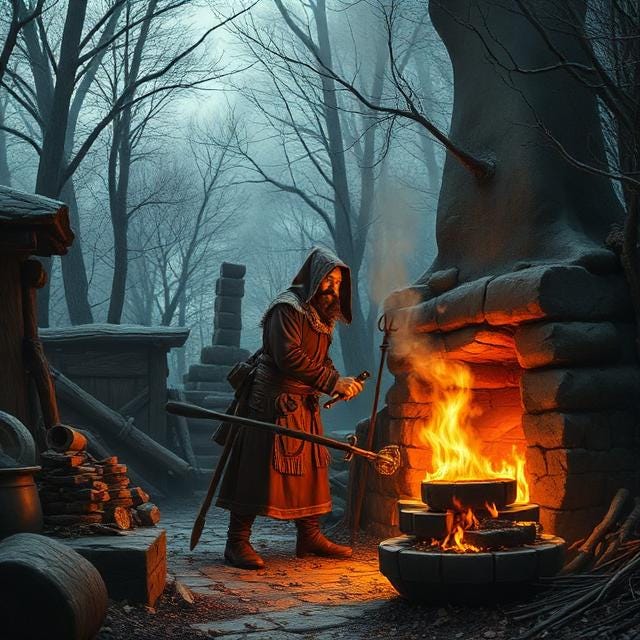
I still remember them, every one. Mother, father, brothers, sisters, aunts and uncles, cousins. And beyond them, the tribe. The tribe was everything. We were not high born - a common lot, my lot. But my family were craftsmen and women, every last one of us. My gift, in part, comes from them, but I arose from something before them, a deeper place that lies far beyond the middle earth, beyond even Asgard and Yggrastril.
Listen! I take you back to a time before there were gifts, into the long ages of mankind’s childhood. After that came a time of copper, of tin, of bronze and then iron, and on to all the things in the world that you know and use today. Back then our tools were stone and sinew, fibre, skin and wood, for eon after eon after eon after eon.
But the world was waiting. It was waiting for me.
I was four years old. Toys had not yet become tools and the world was full of magic - the ordinary magic, cast by a child’s eyes. Remember it. When everything was new and and unquestioned, when explanations were not needed. Magic days, when magic is every day. It was ordinary. I was ordinary. My family and my tribe were ordinary, but they were gods in my eyes.
We were travellers. We all were, back then. We followed the game around the landscape, travelling up and down our home valley and into the hills beyond. The stone in our valley was hard but dull and if we wanted good tools we had to trade for flints or chert from the south or north. My father was a toolmaker. He made very good tools. No one ever made better tools, save only one and that was me.
My father was a strange man. Dark skinned, darker than most folk hereabouts. He was an outcomeder, nobody knew from where. He was a tall man, with long, thin bones, whereas most of us were stubby, hard folk - tough nuts, we liked to think. He could not bear to be inside, but sat out all day and slept out when he could, even when it rained. For which reason the children teased him and called him frog. But they did not dare to get too close, because he was as famous for his temper as for his stonework, and also for his immense strength. He could throw a child over a small tree, I was told - and had done it once, before he was told that he ever tried such tricks again he would be cast out for the beasts to chew.
When I was born he was already old, his hunting days were past. He helped sometimes with fishing, with drying fish and meat, with foraging, but mainly he was a tool maker. He sat under his shelter all day, chip, chip, chipping away, until the frail and beautiful shapes emerged from the brittle flints. He would line them up on the fallen tree beside him, and people would come and inspect them and choose the ones they liked best. Our family never went short of meat, because my father - you understand this - my father was the best toolmaker anyone knew of, or remembered, or cared to imagine.
My mother wove. Blankets, cloth, ropes and string. Nets. She invented knots, some of which you use to this day. Unlike my father, whose skills are now extinct, her skills are still used, still held in regard. She cooked. She painted. She made images with clay and bone and ivory, objects so beautiful people worshipped them. I carried one in my pocket for years, an image of myself as as baby, snug in a wrap. In the end the cloth wore away all the features, and now all I have is a nub of ivory with the faintest of lines showing where a face and wraps once were; a memory of love in bone. She excelled at everything she did. My father was a proud man with a thousand miles of patience for things and none at all for people. He thought his work was perfection, never to be surpassed forever, but his work has been replaced. It is my mother’s skills that have survived.
Where are they now? - all dust. They and all my tribespeople live in my memory but there is no life in memory, after all. Buna, Bil, Eistla, Guðfinna, Gunnborga, beautiful Himinglæva, Jóríðr, Mergret, Oðin-Dísa, Þórhalla, Wīwijō. At night their faces parade in front of me. I am unable to forget them, the people of my tribe. How else could it be? I could as easily forget my arms and legs.
So it began for me as it began for you, with childhood. Mother, father, sisters, brothers, friends. Play. Learning. Being good, being bad. You know the story. Instead of all that, I shall tell you of the first gift. It was not recognised at first, not by any of us, including myself. How could any mortal child imagine such things as have happened to me? There was no skill involved. It was only later that my luck was recognised as something more, a clue to my future - and yours, perhaps.
I was on my own. I was often on my own. I had friends - what tribesman doesn’t? Many friends, and enemies too, all of my people, my tribe, my blood. Still, I was of that kind who would go off on my own. Not far - there were beasts in the woods and rivers that were to be feared back then. But I roamed away anyway where my mother and the women of the tribe had told me not to roam, even when other little ones had disappeared before me.
The gift occurred near the river below a bank of sandstone that reared from the bank, out below the willows and aspens. I was four years old and I was digging in the river bank. Digging, digging, I was always digging. Another clue there, if you care to follow it. Why would a child want to spend their time scraping in the earth? Here’s an answer, the same answer as always. It is love.
I found some soft clay by the river bank and scooped it out. I began to play with it, to make shapes like my mother did. A dog, a man, a woman, a fish. So I didn’t notice it at first, the flint. That’s what it was; the first gift; flint. A good flint, with no veins or other flaws, perfect in itself. It fitted into my hand like one of my own bones. It only needed a little working to sharpen its edge. So hard - and yet it flaked to a sharp edge so easily, as if the shape I wanted was waiting within. I was delighted, because although clay was there for the taking, flints were precious to us. I dug deeper, hoping to find more, and I found a vein of it, a fine thick vein nearly a meter wide of strong flint running along the bank and back away from it.
I wasn’t surprised, I was too young for surprise. When you’re so young, everything is new and new is normal. I knew perfectly well that there was no flint in our land, but now, look! Here was flint. So what? Everything was either the same or it was new or it changed. There was no difference in my eyes.
I thought I might tell my father about it, since he loved flint so much, but then I thought, better not. He kept his flint very close to him and only let us children play with the the chippings. He might disapprove of me having any. I thought I might tell my mother, but then I thought I better not tell her either. I don’t know why. Perhaps I felt even then that this was not good luck at all, but bad luck in disguise.
Sitting there in the sunshine of a spring day, I made my first hand axe – a little one, to fit my little hand. I was very proud of my achievement, and although I had decided to keep the stone a secret, I kept it with me. And of course within the day my father spotted me digging in the ground with it and came and snatched it out of hand.
‘Where did you get this?’ he demanded. It was a great puzzle for him, as no one spent their valuable time making tools to fit a child’s hand. We grew into our tools in those days.
‘I found it and I made it,’ I told him.
He turned it over carefully in his hand.
‘You didn’t make it and you didn’t find it.’ His face darkened. ‘You stole my flint!’ he hissed. His hand shot out and he struck me, hard. ‘Who made this? Who made this?’ he yelled, all the while lashing at me. No one went near my father’s store of flint. He kept it close.
The beating went on and on because my brain would not find a decent lie to make him stop. My father was a strong man, too - stronger than it seemed possible for him to be, with his long bones and sallow skin. He lost his temper and for a moment I feared that my own bones might be broken, or worse. But in the end the women came and made him stop. So that was my first reward for my gift – to be beaten. I carry scars from his beatings still, here on my side, two on my face, here and here, and another on my arm, here. No man should beat a child so hard, and for what? - a truth he was unable to believe.
My mother was scared I think, and I was told she upbraided him later for his violence. But she supported him to my face, even so.
’You shouldn’t have lied to him, and such a stupid lie,’ my mother said. ‘You know how he is for his stone.’
‘It wasn’t a stupid lie,’ I said. ‘It was a stupid truth.’ She laughed then, and let the matter go.
‘I’ll be watching you,’ she said. She looked at me with a frown. I was known not to lie, but how else could this be explained?
I have that axe still. It’s like a miracle even to me, so small, so perfect, made by a child of four, who had never chipped a stone before. I take it and hold it my hand often, and every time it fills me awe. What genius I had when I knew nothing! It makes me afraid that next time I try to make something it will come out bad, now that I know so much. It was perfect, that first thing. How can I ever reach perfection again? And yet, I do. Experience, it seems, doesn’t come into it.
My father took it away. I never saw it again in his lifetime. For a long time I believed he had destroyed it, but years later, during the searching years, I found it in another land. I was sitting on a bank, I looked into the water and there it was, just under the surface. I simply reached down and took it out, still perfect - more than perfect, because it had been lost and now was found.
Perhaps my father threw it away. Perhaps it was lost when our tribe was lost. I know I saw him often looking oddly at me after that. At the time I thought he was suspicious of me. Perhaps it was awe. I wish it was love, but he never showed me that. Perhaps he felt it in his heart, but what is not shown we can never know.
Questions! How did a vein of flint occur in our Yorkshire grit? How could a child so young make something so perfect? How did the axe come back to my hand after so many years, to be lying in a river so distant, in another land from where it was lost?
In the answer to these, you have the answer to me.
A few days later we moved on and the flint in the ground was left behind. No one knew about it but me, and all the time we travelled, I remembered it. I thought about it, I dreamt about it - I loved it. How I loved it! Already, although I had no idea how precisely and particularly mine it was, I knew it was special, and that it made me special … so special, in a strange way, that I was scared to share it. I am a tribesman. To be special is to be different and therefore hard to bear. I have found it so.
I knew I would tell, of course. I was a child, very young, but I already knew that what was mine was the tribe’s too. Back then, our people were a part of us. There was no difference between ourselves and them. We were all one. Alone, we could not survive. Alone we were lost, we faded and soon died, if not of starvation or hunted by beasts, then of a broken heart. Only our flesh was ours. Our soul and our mind were one.
And yet ... and yet I did not tell. Still! Perhaps it was my father’s fault, for beating me so hard for what I had found. He alone of all the tribe was somehow not of the tribe. He made it clear that his flint was his, not ours. He was strange among us for that. I don’t think we would have kept him among us if it were not for his great skill. Perhaps then, I am a little bit like him - just a little.
I was scared that if I told the tribe about the flint, that I would loose myself - what I was, what I was becoming. I did not know then that any amount of sharing cannot dilute a man. But this was the first gift! To this day I can recall the moment it came into my life. The feel of it, the warmth of it in my hand. Yes! The minerals of the earth are warm to my hand, like the flesh they once were. I swear I even loved the bruises and cuts that my father had left, because they had been caused by the flint. How strange am I! I was a child, all things were the same to me, but when I closed my eyes, I could literally see that vein of flint spreading under the ground. Ymir’s bones, secret bones, known only to me.
Yes. Another clue.
Time passed. The memory stayed with me. As time passed it did not diminish as memories usually do. It grew clearer, more vivid. Stronger. I bided my time. Weeks passed, months passed, and now I could remember every chip, every plane, every smear of clay on its perfect surface. Although I was just a child, and riven with desire, still I kept my silence. My obsession grew. Bt the time we came back, nearly a year later, I went to meet the flint again half expecting by then for it to have left - that had become disillusioned with me and had left to charm another boy, or that it had been an illusion, a dream, or perhaps that it had just got bored waiting for me. It was a summer’s day, bright with sunshine and dappled by the leaves on the trees above me. I went alone. I dug in the warm damp earth by the river and there it was, just a few inches below the surface, exactly where I remembered it, like a bone nestled in flesh. I leaned back, my arse in the water, and looked along its length hidden below ground, out of sight but still somehow there in my eye - snaking its way along the river bank and then moving inland for twenty or thirty meters. How I knew this, I did not know. But I knew it as clearly as if I could see it naked before my eyes, like a living thing under the ground.
Ymir is dead, but his bones live on. It seems that even Odin cannot kill the world stone dead.
When do the stones in the earth appear out of place for no reason? The answer; when Wayland is near. But I didn’t know that then. I only knew that there was a vein of flint in the ground under the sandstone cliff, and that I needed to be with it.
The years of a child are a time of learning. By the time I came back to the flint I knew much more than when I first found it.
‘Little ears are flapping,’ my mother used to say when we children waited for secrets. But no one hid how important flint was, and what a burden it was to us that it did not occur in our lands. We had to trade for it, carrying it on our backs in exchange for the good things we did have. By now I understood very well that what I had found was a great gift, a treasure, an asset to us all. Because of that, because of the tribe, because I was part of the tribe, I understood that now I had to tell.
But - not yet. Not yet. In this I was still a child, knowing the value of things but not the timing. Owning came to me before sharing; I am not a good person. Like a miser, I kept it hidden a while longer, a secret, lying quietly there inside the earth. Silent though it was, that stone was loud to me. Secret though it was, I knew everything about it. When we walked past it the river bank where it hid, I held my breath in fear that the others would see it, or hear it, or smell it, or feel it like I felt it, a sweet ache under their own skin.
I kept it to myself for a week. But how it weighed on me! I visited it when I could. I picked out stones of the right size, shape and quality and I made things … arrow heads, axes, awls. You have found such things in the deep layers where people once lived. I hid them in the grass by the river bank, but I knew it had to end. I had a treasure. What I did not know then was that the stone was not the treasure; I was. But even if I had known it, it wasn’t in me to hide it from my people. So one day I took my mother by the hand and led her to the spot where it was hidden. Although it was facing away from the current, the river covered it up each day and kept it hidden for me. I dug in the mud while she waited impatiently. Once again I was unsure that I was going to find it. What if it really was just for me? My father said I had lied; I knew I hadn’t. But had I dreamed? I was a child. What did I know of what is real and what is not real? What did I know of impossible and possible things?
But the flint was there. I cleared the dirt off it and a piece broke off into my hand, which I handed to her and showed her where it come from, the vein of it, a great wedge of it, bigger than anything any of us had seen.
My mother crouched down one knee to look at it better.
‘It’s a vein,’ she said, glancing back at me. I nodded. She paused awhile, a long while, so long I almost thought she had gone to sleep squatting there by the river bank, with the martins soaring past us and the river flowers nodding in the breeze. Then she knelt, both knees in the soft clay for a long while, before she looked down at me and said, ‘This should not be here, Wayland,’ she said. I nodded. Of course, to her the presence of this flint here, in the this clay, was unnatural. But for me, nothing could be more natural.
‘Lord Odin,’ she began, raising her face to the sky, and she began to pray to Odin, thanking him for what he had given us. But it was wrong.
‘Mother,’ I said. She looked down at me, shocked that I should interrupt such a prayer. But it was wrong. ‘’You should be looking down when you pray,’ I said.
‘To Hel? Why would she give us this gift?’
‘Not to Hel.’
‘To who?’
I shook my head. I didn’t know. ‘To the earth?’ I guessed. The stone after all came from the earth.
‘Jörð, our mother earth?’ She smiled at me - amused, I think, because I was a child. ‘This is not from her. Nothing grows in the hard stone, Wayland.’
I knew Odin was wrong but I had no answers as to why. I hazarded another guess. ‘Ymir,’ I said.
There was a long pause while she stared into my face.
‘Ymir’s bones,’ she said.
‘They come from the earth,’ I said.
‘Ymir is dead, Volund,’ she said.
‘But this flint is his bones. All stones are Ymir’s, aren’t they, mother?’
Again that long pause. My mother was troubled.
‘Not just the stones,’ she said. ‘If Ymir came back to life, the world would end. The sky is his skull, inverted over us. The earth we walk on is his flesh, the rocks beneath our feet are his bones, the mountains are his bones. No. Odin must have given this gift to us. It was him who killed Ymir and made his body into the seven worlds. He gifted the world to us. These stones, old Ymir’s bones, are his to give.’
So she went on with her prayer, with me beside her. I knelt next to her and lifted up my face and spread my arms to the sky, but my spirit was offended. Yes, I was offended that another god, even Odin, should get the credit for what for what I had found, when it was nothing to do with him. Every time she said his name, Odin, I whispered, ‘Ymir,’ to myself. That made me feel better about it.
Looking back now, I think she was scared. She thought Odin would be jealous. Perhaps she was right. Everyone fears Odin, the greatest of all living beings. But in my heart, I worship one greater even than him - even in death.
We walked back to our camp, where my father was sitting outside the round house as usual, chip, chipping away. My mother told him she had something to show him. She didn’t show him the flint that had fallen into my hand and at first, he didn’t want to come, but she was insistent, so he put down his stones and followed us. When we arrived his complaints at having to leave his work fell silent. He bent to examine the vein closely.
‘It goes underground for fifty steps or more,’ I told him. He turned to look at me, then back to the flint.
‘Wayland found it,’ my mother said. ‘It is a great asset for our tribe. He should not have been beaten for it.’
There was a silence. My father stood up and snorted. I held out my hand to give him the piece of flint that had been given to me, which he took and held close to his face.
‘It’s the best stone,’ he said. He began to nod his head rapidly. ‘This changes everything for us all. We must stay here, at this camp. No - we must make a new camp on this very spot. If others find out about it – when they do – there’ll be raids. Our peaceful days are over.’
He gave us both a curt nod walked back to our camp. My mother was furious. She called him back, but he waved his hand in the air at her as if he had better things to do, and so she berated him, which he hated. But he didn’t dare complain, because if he did she would do it again in public. Among us in those days, it was the women who made the plans, who organised, who led. My father was a man who never liked to do as he was told, but when it came to it, he accepted it - he had no choice. So he came and made his peace with me, looking not in my eyes but to the side of my face, as if he were the child, not me. I stood as tall as I could and looked him straight back - a boy of eight years to a man of his age and status. He told me he had been wrong, and that I had made a great new life for our people with my discovery. I looked him back in the eye and accepted it as my due.
‘And the flint that I made, that you took,’ I said when he was done, in my piping little voice. ‘I want it back.’
‘It’s gone, I don’t know where. I am sorry, but I will help you make new ones.’
There was a tone in his voice that told me then, right from the start, that he wasn’t happy to have me as his apprentice. But I had shown skill, he was my father. How else could it be?
I loved my father. Even now, after so many centuries, I can still find a place in my heart for him. But he was not a worthy father. For this reason, despite the love I held for him and that I still hold, I shall not pass on to you, my reader, his name. My mother, Egil. But my father, no. Let him, father of me, father of my gifts, remain in the shadows.
He looked at me a while, as if he had more to say, but never did. Instead he snorted again - a habit of his - and shook his head. His long ears, that stuck out from his thinning hair, shook slightly at the top. The other children used to tease him about his ears, which drooped slightly at the top in a way no other ears you ever saw on mortal man did. When I was very small I asked my mother about those ears and where they came from, but all she told me that when he was young, his ears were stood tall and stiff but now they were soft, and she put her hand to her mouth and laughed. As I say, my father came from away, an outcumden, as we called them then. No doubt he brought his ears from his past.
The flint, as my father said, changed everything. We had assets now, wealth; and wealth must be guarded. We became settled. We built our shelters to last. We took our flint to trade with other tribes, for meat and fish, for roots, and other things, including things we’d never owned before in our lives. Furs from beasts we’d never seen, skins, beads, coloured stones, clothing already made, leather, string, sinew pre-prepared, fruits dried. People began to decorate themselves more. Men, women and children walked around with painted faces.
That very first day, the day we showed my father the flint, the seam was guarded; and I was not allowed near it. I was a child, of course I was not allowed near something so valuable. Our elders set up their Things by the flint. There were shelters, armed men and women by it day and night. It was too important for a child.
I understood; and I was sick with rage. What did they think, that I would break it? That I would sell it, that which I did not own? Already there were hints in my mind of what was to become. I had found it, this impossible flint. Why was I not guarded, why was I not invited to the Things, why did no one see that my luck was not luck the way a man has luck, not a thing of chance or carelessness, but something with import and meaning. Not luck at all.
Of course, no one understood. They all thought my discovery was an accident - a child at play looking in places no one else looked in, for things no one expected to find. I knew better. I dreamt better. It was to be a long time, after I had received many other gifts, that I began to receive my due.
It began. I started to have visions of what lay beneath the earth, both close too and far away. I saw Ymir’s bones in seams, in layers stretching out across our lands, across and under rivers and mountains, down beneath the sea. In those unreachable seams I could see the flints sitting like birds perched inside the chalk and other rocks, and I knew exactly what tools they would best be. This with stones hidden half a mile below the surface and many miles away. I could see other stones as well - the dark granite, the shining marble, the soft sandstones. Yellow rocks, green rocks, red rocks, although I had no idea what they meant. And others - the shining rocks, white, red, yellow, green and blue. Yes, at such times of vision my eyes could see what was hidden, they would shine for me even though they were in darkness deep, deep down, far down, away from the sun, where they had never known the light.
In the night, through my dreams, I came to believe that what I had told my mother was true - that it was not Odin but Ymir, the slaughtered god, who had given me the flint. I saw how he had fallen in love with beasts no longer with us, how he had taken their bodies and made prints of them, as lovingly as any artist. Nothing so huge that was once alive can ever be entirely dead. I saw no image of him, heard no voice, but as the weeks and months went by I knew, as surely as if I had held his hand and looked into his face, that it was Ymir who loved me, Ymir who gave me the gifts. But I said nothing, I kept it all to myself. I had learned a wrong lesson - one of the first lessons I learned; that what I knew, what discoveries I might make, could be taken from me. This was not like the tribe as I knew it, for with the tribe, what one has, all have. But now, what one had, all had except he who had found it. I hated that, but I understood it. We were a tribe, we were together, a people bonded, a bond that could not be broken; but this was wealth. This was different to what we had ever had before. I knew I must submit to it, but I also knew that the tribe was wrong. This is why I kept quiet, not because I didn’t want to share, but because the sharing did not include me.
Sometimes I teased my mother.
‘Underfoot here there is the skull of a dragon. One day in a hundred or a million years, the wind and the rain will wear the rock away and the people will see, and they shall all be amazed.’
Of course my mother did not like these prophesies, not knowing that to me, they were simple truths. At first she thought it was games, a child’s play with his own pride. But one day I showed her the giant bones that I had predicted on the roof of a cave. She beat me then.
‘One day there will be a time for these visions,’ she told me, her voice shaking. ‘But until that day comes, you must keep them to yourself.’
And I was pleased because I had been told that my secrets were for myself alone.
We became rich. My father had a black axe made of obsidian, another made of crystal, traded from hand to hand from distant countries. Such things were magic, totemic, omens in themselves. He used them to sacrifice beasts to the gods. He became rich enough to buy himself a bigger crystal axe, which he then re-worked into a smaller one, a better one, a thing of great beauty. I do not know, I have not seen everything, but that axe may be the finest thing that was ever made by the hand of any mortal man. His work became known far and wide, passed from hand to hand among the people, far into Europe and beyond, even into Asia. To own a piece made by my father was a thing of pride. People travelled hundreds of miles to put a piece of stone they valued into his hand, for him to shape for them.
Meanwhile, my skills slept in my hands.
Wealth! Who can pass it by? But it buys more than you pay for. Envy, which we had not known before, began to plague us. Inside our compound, arguments began - who had what, who needed what, who wanted what, who should get what. Outside, threats multiplied. Our compound became a stockade. Our young men and women gave up the old life of hunting and gathering. They did nothing for themselves but everything for the tribe - they became warriors, soldiers. All day they played games - running, lifting, throwing, practising for the fight when it came. We fed them the best of what we had. When there was no one to fight we set them to work on the stockade, building it higher, stronger, better, all the while making themselves higher, stronger, better.
This is the price of wealth. And, mortal, know this; I am the source of wealth, all wealth. You will soon see how it comes about if you have not already learned. Already my story begins to tell its tale.
We learned all this, we had to. We held our assailants off. Heads appeared on spears around the encampment, to warn others that we would not hold back to protect what was ours - and we did not. Men and women were killed all along our walls. Those we captured were flayed, raped, killed slowly. Inside, the flint nappers, my father and others, worked steadily away, producing things to trade and to protect us.
And what of me? What of the source of all this wealth, this violence, this terror … this owning that suddenly overwhelmed us? I was not a part of it - not yet. In fact, I was not there at all. I was sent away. I went with my mother and the other young ones and their mothers on the old way, the travelling way, to fish, to hunt, to gather, while the men made their wealth as if it belonged only to them.
I was scared that people would blame me for this changes in our lives - for the deaths and cruelty that my discovery had caused. There were plenty of people who thought the flint should have remained buried in the earth, who preferred our old life to the new. When children and fathers and brothers and sisters died defending cold stone, there were tears, anger, threats. Where we had all lived together, now we were apart. Where we had been safe from other tribes, now we were in danger even from within. Where everything had been held in common, now you had to ask for a share for it to be given.
‘You call this a blessing? It’s a curse!’ one mother shouted at me when she heard her husband had died in an attack.
There have always been such complaints over the aeons as they pass - when the stone became metal, when the swords became guns, where the the guns became bombs. What is it to me? I make ploughs as well as guns. It’s not my business to say how tools must be used. I do as I am told, as the gods must answer all prayers. I make what I am asked to make, I accept what the earth gives me and do the best I can with it.
Today, I look back on those days after I received the flint, but before I was allowed to work with it, as the golden days of my life. Mother, innocence, play, learning. Sunny days, rainy days. Small creatures in the grass, flowers in the woods. The smell of rain and dust and mother. These things are the foundation of all our lives. They remain with us, sweet memories that seem to mean nothing but shape our earliest selves, like jewels inside us. It’s the same for you, surely? For every one of us, man, woman, god, Jotun, dwarf, elf. Who can withhold a smile when memories like these come to mind?
But it did not seem to me like that at the time. I cannot deny how angry I was that I was outlawed from my own discovery.
My mother said, ‘Make the most of this time with us, Wayland. In a few years, these times will be gone and you will doubtless be with your father, napping the stones all day, every day; but even tomorrow can cut our lives away. Who knows what will happen to any of us? We are your family. Enjoy being here with us. Don’t try to cut our time together short.’
Although I was at such a young age, although I loved the stones as the stones loved me, I knew her words were true. I was a small boy. What else matters so much to any of us as our people? But only the very young seem to truly understand this truth. I loved my mother, I loved my brothers and my sisters. Her words bit into me, and I resolved that whatever gifts came my way, I would never cease loving the people … my mother, my brothers, my tribe.
I would never, in short, become like my father.
But - the gifts. The gifts, having started, did not stop. They have never stopped. I searched among the grasses and shrubs and in the loose earth for flints that I knew should not be there; and I found them. Yes, you see? I was a miraculous child. At last I began to understand it. It was more than skill, it was more than prodigy. Consider; how did I find a vein of perfect flint, when there was none in our lands? Why did a flawless piece fall off it into my hands, of just the right size for my axe? Consider; why did such pieces continue to appear before me, of the right size, shape and consistency for whatever tool I wanted to make? Where did the flints that I sought come from, laid so easily in the long grass, among the heather, in the crook of a tree, wherever I choose to look? Why did no one else ever find them?
I was gifted. But by whom?
The gods have made that claim. Loki has said that he saw my fate and felt pity for me, knowing that I had talents but that my jealous father would never help me for the fear that I would very surpass him. It is true, my father was a jealous man. It is in Loki’s power to hide those flints, to whisper in my ear at night where to look, to guide my hands, my fingers and arms until my muscles knew skills that I had never been taught. But why would he? Loki, like all liars, talks about the truth all the time. I only say what I know and I only know what I see. It happened. That’s all.
Tyr, the god of war, has claimed that it was him. It is in his interest of course that someone is there to make armour and swords, guns, tanks, planes. He woos me, he flatters me, he favours me. But I don’t believe any of it.
It is none of them - no one living. No; it is dead Ymir who loves me, not Loki or Tyr or Odin. Ymir, first of all, a being so vast that Odin was able to make the universe out of his body parts. From beyond his death he guides my hands. In this sense, my gifts are not my own. I have no credit in it. It is given to me, all of it. And I have no idea, no idea at all, why that should be so.
My mother knew what was going on. I had shown her the dragon’s bones, remember? She watched many times as I parted the grass and lifted up a stone. She saw how it fitted my hand. There was never any struggle to make things work. She saw how the stones craved my touch, to be held, to be shaped by me, to feel the warmth of my blood against their ancient chill. But she never said a word, except to tell me to do my tricks out of sight, in case I was misunderstood.
So the years passed. I made stone tools and showed them to no one. I hid them in the long grass where I had found them. I knew I’d find them again when I looked. Who would steal them? The beasts? The birds? Of course not. Then my fellow tribesfolk, perhaps? Of course they would have - if they could. And yet they never found a single one. Even my mother. I saw her search where I had hidden, knowing exactly where I had dropped my work, and she found nothing. Then before her eyes, I retrieved it from the spot where she had searched and found nothing. She nodded to one side of me … to say that she knew, she had seen, but that she would not say she had seen, even to me.
` You see? Ymir made sure they were safe. He still does, despite all the ravages I have undergone. It is not the warm flesh of our mother earth who loves me. Deeper than that, under the flesh, in the stones and ores and crystals., where the ghost of dead Ymir dwells. That is where the love for Wayland is held.
I could say my skills increased - so they did. But perhaps it is better to say that I became a better vessel for Ymir to speak. I opened myself up to him, and he entered me. That, really, is all the skill I have. I learn better how to receive what is given to me. Sometimes, I feel that I myself barely exist at all.
All I am is a man who is strangely loved.
So the time passes. Three years I spent in the wilderness, away from the flint. Day and night I thought about the time when my apprenticeship would begin - when my gifts could at last become public - when I could give myself to my tribe, as is right. I thought of my father - my father who was a stranger to me. We would become father and son, like other fathers and sons. He would teach me. Perhaps, with pride and humility, I would teach him. He would learn to love me and he would learn to show that love. We would sit together and tap, tap, tap at the flints, showing each other our creations and complimenting each other on the skill, the craft, the luck, that led to some beautiful artefact. These were my childish dreams. But who does not dream of such things? Like a fool, I dream of them still, though he is long gone from all the worlds.
But when the time came, I was not apprenticed to my father. He did not want me. He was too busy, he said. He earned too much for the tribe, his skill was in making, not in teaching, he said. That last thing was true, I know that much. The young men and women who sat at his feet were not the lucky ones. In this respect, I was lucky, I suppose - lucky for my learning, if not in my father.
But it was all excuses. What he meant was, he was too important, too selfish, too caught up in his own story. He was not truly one of us. He was never a happy man, my father. Who can be happy if they do not give themselves to their people? Even when he sat napping the stones he looked fierce and anxious. How could anyone be happy, so wrapped up in themselves? He was beyond himself all the time.
My mother said, ‘You must learn how to love people all the more fiercely, because he cannot.’
I was a child, I loved and respected my mother. I tried to follow her words, but in the end I discovered what we all discover - that love is personal. It is between you and the loved one. None of us are able to love for others. So my father’s life was without love. There is some kind of justice in that.